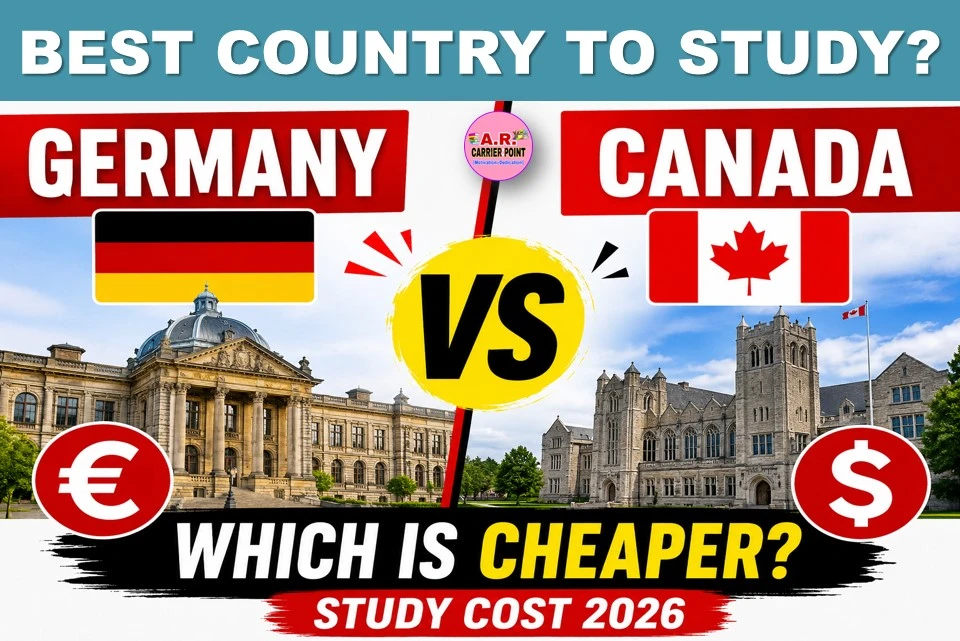
Cost of Living and Studying in Germany/Canada- Studying abroad is a dream for millions of students worldwide. Among the most popular destinations, Germany and Canada consistently rank at the top due to their world-class education systems, excellent career opportunities, and high quality of life. However, before choosing a destination, students must carefully evaluate the cost of studying and living in each country.
This guide provides a detailed comparison of Germany and Canada, helping students make an informed decision about their higher education journey.
Why Compare Germany and Canada?
Both Germany and Canada offer internationally recognized degrees, multicultural environments, and strong employment opportunities after graduation. However, the overall expenses can vary significantly depending on tuition fees, accommodation costs, transportation, healthcare, and daily living expenses.
Understanding these costs in advance helps students plan their finances and avoid unexpected challenges during their studies.
The Core Philosophy: Free vs. Paid Education
The fundamental difference between these two destinations lies in how higher education is funded. Germany treats education as a public good, whereas Canada operates on a highly commercialised, tuition-driven model.
| Expense Category | Germany | Canada |
|---|---|---|
| Tuition Fees | €0 – €1,500/year | CAD 15,000 – 40,000/year |
| Accommodation | €300 – 800/month | CAD 700 – 1,800/month |
| Food | €150 – 300/month | CAD 250 – 600/month |
| Health Insurance | €120 – 140/month | CAD 50 – 100/month |
| Transportation | €0 – 49/month | CAD 80 – 150/month |
| Total Monthly Cost | €700 – 1,300 | CAD 1,200 – 2,500 |
Germany’s Free-Tuition Ecosystem
In 15 out of 16 German states, public universities charge zero tuition fees for both domestic and international students. Instead, students pay a nominal “Semester Contribution” (Semesterbeitrag) ranging from €150 to €400 per semester (€300 to €800 annually). This fee is not tuition; it covers administrative costs, student union operations, and a highly valuable Semesterticket that grants unlimited access to local and regional public transit.
Note: The state of Baden-Württemberg charges non-EU international students €1,500 per semester, which remains exceptionally affordable by global standards.
Canada’s Market-Driven Tuition
Canadian institutions charge international students significantly higher rates than domestic residents. Depending on the university, province, and field of study, international undergraduate and postgraduate tuition typically spans CAD $15,000 to CAD $40,000 per year.
Premium programs such as Data Science, Engineering, or an MBA at top-tier institutions like the University of Toronto or the University of British Columbia can easily exceed CAD $50,000 annually.
Living Expenses and Visa Financial Proof
While Germany easily wins the tuition debate, your daily survival expenses tell a more nuanced story. Both countries enforce strict regulatory minimums that international students must hold in verified accounts before setting foot across their borders.
Germany’s Blocked Account (Sperrkonto)
To secure a German Student Visa, the Federal Foreign Office mandates that applicants demonstrate financial self-sufficiency through a Blocked Account. The current federal requirement is €11,904 per year (broken down into a capped monthly release of €992).
- Under the Hood: This fund ensures you can cover standard student accommodations, compulsory statutory health insurance (approx. €120/month), groceries, and learning materials.
- The Geographic Reality: While €992 is perfectly adequate in affordable university towns like Leipzig, Chemnitz, or Bremen, it will feel incredibly tight in high-demand, high-cost metropolitan hubs like Munich or Frankfurt, where rent alone can swallow €600 to €800 of your budget.
Canada’s Restructured Financial Thresholds
In response to severe domestic housing shortages and escalating grocery inflation, Immigration, Refugees and Citizenship Canada (IRCC) drastically altered its financial entry requirements.
For a single applicant outside Quebec, the minimum proof-of-funds requirement sits at CAD $22,895 per year, plus the cost of your first-year tuition and travel expenses.
- The Total Ledger: In practice, international students should anticipate true living expenses ranging between CAD $1,200 and CAD $2,000 per month (CAD $14,000 to CAD $24,000 annually).
- Urban vs. Rural: Vancouver and Toronto consistently rank among the most expensive real estate markets in North America. Opting for institutions in the Prairie provinces (Manitoba, Saskatchewan) or Atlantic Canada (Nova Scotia, New Brunswick) will sharply lower your overhead costs.
Mitigating Costs: Part-Time Work Frameworks
Working while completing your degree is an excellent way to offset your recurring daily expenses, though both countries place clear boundaries around student employment.
The German Work Model
Students coming from non-EU nations are legally permitted to work 140 full days or 280 half days per calendar year. During the active academic semester, you are capped at 20 hours per week, though this limit is waived for full-time work during university holidays.
- Earning Potential: Germany features a robust national minimum wage (€12.41+ per hour). Working a typical student job can bring in €500 to €800 per month, effectively offsetting a substantial portion of your local living costs.
- The Hidden Barrier: While casual jobs (working in cafes or logistics) require minimal linguistic skill, securing high-paying, degree-relevant student positions (Werkstudent) heavily relies on your proficiency in the German language.
The Canadian Work Model
Following a series of temporary policy adjustments, Canada finalized its off-campus work authorization rules. International students can legally work up to 24 hours per week off-campus during active academic sessions, with no hourly restrictions during scheduled seasonal breaks.
- Earning Potential: Minimum wages are provincially regulated, spanning roughly CAD $15 to CAD $17.40 per hour. Working 20 hours a week can generate CAD $1,200 to CAD $1,500 monthly.
- The Linguistic Advantage: Because Canada operates entirely in English (and French), international students can instantly interview for client-facing, professional, or campus-based roles without facing a structural communication barrier.
The Post-Graduate Return on Investment (ROI)
An international degree is fundamentally an investment toward long-term professional or immigration goals. How you recoup your educational expenses depends heavily on post-study work visa structures.
Germany: The Career-Driven Pathway
Upon graduation from a recognized German university, you are entitled to an 18-month Job Seeker Visa to find a position that directly aligns with your academic qualifications.
- Immigration Outlook: Once you secure a skilled employment contract, you can seamlessly transition into a Work Permit or an EU Blue Card. Germany’s streamlined immigration laws mean skilled graduates can apply for permanent residency in as little as 24 months of working.
- The ROI Factor: Because your upfront tuition was nearly zero, your time to achieve a positive ROI is incredibly fast. However, your career mobility in the local market remains tied to your technical competence and German language fluency.
Canada: The Express Immigration Pipeline
Canada’s Post-Graduation Work Permit (PGWP) framework provides an open work permit for 1 to 3 years, directly scaling with the duration of your academic program.
- Immigration Outlook: This open permit allows you to work for any employer across the country. Historically, accumulating Canadian corporate experience serves as the premier mechanism for scoring points within the Express Entry comprehensive ranking system to earn Permanent Residency (PR).
- The ROI Factor: Because the initial capital layout for Canadian tuition is high, students face prolonged financial pressure to secure high-paying, post-graduate corporate roles to balance their books.
The Verdict: Which Country Fits Your Budget?
Your ultimate choice should map closely to your liquid capital reserves and long-term linguistic comfort.
- Choose Germany if: You want to minimize student debt, possess a strong interest in STEM or engineering fields, and are genuinely excited about the challenge of learning the German language to unlock local corporate networks.
- Choose Canada if: You or your family can comfortably afford a higher upfront tuition investment, you prefer an immediate English-speaking environment, and you want an express, structured pathway to permanent residency and integration into the North American market.
FAQs
Is Germany cheaper than Canada for international students?
Yes, Germany is generally much cheaper due to free or low-cost public university education and lower living expenses.
How much money is required to study in Germany?
Students should budget approximately €12,000–15,000 per year including living expenses.
How much money is required to study in Canada?
International students typically need CAD $30,000–60,000 annually including tuition and living costs.
Can students work while studying?
Yes. Germany allows part-time work under student visa rules, while Canada permits up to 24 hours per week during academic sessions.
Which country is better for PR?
Canada generally offers a more structured and straightforward pathway to permanent residency.
Important Link
| ARATTAI CHANNEL | CLICK HERE |
| WHATSAPP CHANNEL | CLICK HERE |
| TELEGRAM CHANNEL | JOIN |
| YOUTUBE CHANNEL | SUBSCRIBE |
Keyphrase in image alt attributes